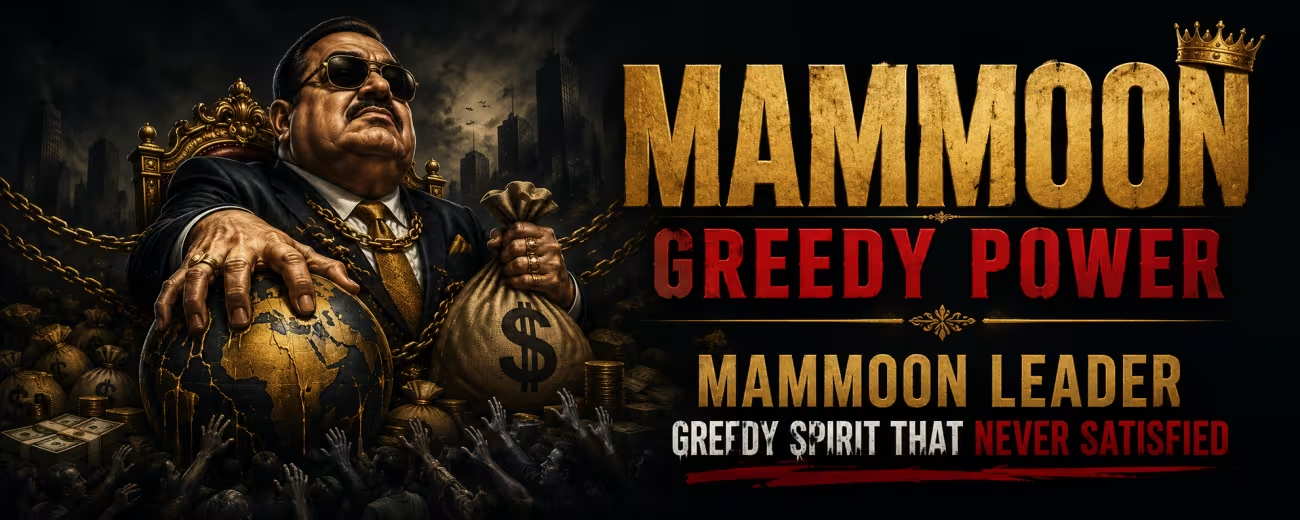
The Spirit of Mammon: Corruption, Greed, and the Crisis of Leadership in the Philippines
Throughout human history, civilizations have risen through justice, integrity, and visionary leadership, yet they have also declined because of corruption, greed, and the abuse of power. While wealth itself is neither evil nor inherently corrupting, the obsession with wealth and power has repeatedly destroyed governments, weakened institutions, and caused suffering among ordinary citizens.
The ancient concept of Mammon provides a powerful metaphor for understanding this phenomenon. Originally an Aramaic word meaning "wealth" or "possessions," Mammon gradually evolved into one of history's most enduring symbols of insatiable greed. In Christian teaching, Jesus warned that "No one can serve two masters... You cannot serve both God and Mammon." The warning was never about money alone; it was about allowing wealth to become one's master rather than one's servant.
In today's world, the spirit of Mammon can be seen wherever public office becomes a means of personal enrichment, where political influence is traded for financial gain, and where leaders prioritize their own interests over the welfare of the people they are sworn to serve.
Many Filipinos have expressed frustration over recurring corruption scandals, allegations of misuse of public funds, political patronage, and abuses of authority. While corruption is not unique to the Philippines and honest public servants continue to serve the country with dedication, the persistence of corruption remains a significant national challenge that affects economic development, public trust, and the daily lives of millions.
This article explores the historical meaning of Mammon, how the symbol applies to modern corruption, why greed becomes self-destructive, how abuse of leadership harms society, and why integrity remains essential for national renewal.
Understanding Mammon
The word Mammon originated from the Aramaic language, where māmōnā simply referred to wealth or possessions. In ancient societies, wealth was considered a necessary part of life, enabling families to survive and communities to prosper.
However, the teachings of Jesus transformed the meaning of the word.
In the Sermon on the Mount, Jesus declared:
"No one can serve two masters... You cannot serve both God and Mammon."
This profound statement elevated Mammon beyond mere money. It became a symbol of misplaced loyalty—a warning against allowing wealth to dominate one's values, decisions, and identity.
Money itself is morally neutral.
Greed is not.
The danger begins when money becomes an idol that demands constant sacrifice.
The Evolution of Mammon
During the Middle Ages, theologians increasingly personified Mammon as a demonic figure representing avarice.
Rather than simply describing riches, Mammon became the embodiment of endless accumulation.
Unlike ordinary financial success, Mammon symbolizes:
- wealth without compassion
- power without accountability
- ambition without ethics
- authority without justice
This literary transformation appeared in several classic works.
John Milton's Paradise Lost described Mammon as a fallen angel whose eyes were permanently fixed upon earthly gold.
Edmund Spenser portrayed Mammon as the guardian of hidden treasure, tempting humanity with endless riches.
Other medieval writers associated Mammon with predators that endlessly consume yet never become satisfied.
The common lesson was clear:
Greed never reaches contentment.
It only demands more.
Greed Has No Finish Line
One of the defining characteristics of Mammon is that enough is never enough.
A person may begin by wanting financial security.
Later they desire luxury.
Soon they seek influence.
Then political power.
Eventually they crave complete control.
The cycle rarely ends voluntarily because greed continually shifts the definition of success.
History repeatedly demonstrates that those consumed by greed often lose perspective.
Relationships become transactional.
Honesty becomes negotiable.
Integrity becomes inconvenient.
Public service becomes self-service.
Corruption as Modern Mammon
Modern corruption represents one of the clearest manifestations of the spirit of Mammon.
Corruption does not begin with large scandals.
It begins with small compromises.
One dishonest signature.
One illegal favor.
One misuse of public funds.
One abuse of authority.
Repeated over years, these actions create systems where corruption becomes normalized.
Citizens gradually lose confidence in institutions.
Businesses hesitate to invest.
Public services deteriorate.
Economic inequality widens.
The greatest victims are rarely the powerful.
Instead, ordinary citizens bear the consequences through poor healthcare, inadequate education, failing infrastructure, and lost economic opportunities.
Leadership and Public Trust
Leadership carries enormous responsibility.
Those entrusted with public office hold resources that belong not to themselves but to the nation.
Government funds represent taxpayers.
Public assets belong to future generations.
Authority exists to serve citizens.
When leaders misuse these responsibilities for personal gain, the damage extends beyond financial losses.
Public trust erodes.
Once trust disappears, rebuilding institutions becomes far more difficult than repairing budgets.
Trust cannot simply be legislated.
It must be earned repeatedly through transparency and accountability.
The Human Cost of Corruption
Statistics often measure corruption in billions of pesos.
But corruption also carries invisible costs.
Families remain trapped in poverty.
Students lose educational opportunities.
Patients receive inadequate healthcare.
Communities lack safe roads.
Workers struggle to find employment.
Farmers receive insufficient support.
Small businesses face unfair competition.
Each dishonest transaction has human consequences extending far beyond accounting records.
The Psychology of Mammon
Psychologists have long studied why individuals pursue wealth even after achieving financial security.
Several patterns frequently emerge:
Fear of losing status.
Desire for recognition.
Competition with others.
Need for control.
Belief that happiness always lies one promotion or one fortune ahead.
Yet research consistently suggests that once basic needs and reasonable comfort are met, additional wealth produces diminishing improvements in life satisfaction.
Mammon exploits the illusion that fulfillment is always just beyond the next acquisition.
Abuse of Power
Power magnifies character.
Ethical leaders use power to protect.
Corrupt leaders use power to exploit.
Abuse of leadership may appear in many forms:
- favoritism
- patronage
- bribery
- intimidation
- misuse of public funds
- conflicts of interest
- suppression of accountability
These behaviors weaken democratic institutions regardless of political affiliation.
Every society benefits when leaders remain accountable to laws rather than personal interests.
Why Corruption Persists
Corruption rarely survives because of one individual alone.
It often continues because systems allow it.
Weak oversight.
Lack of transparency.
Fear of retaliation.
Political patronage.
Limited enforcement.
Slow judicial processes.
Insufficient protection for whistleblowers.
When accountability becomes inconsistent, corruption becomes easier to conceal.
Honest Public Servants Also Exist
Discussions about corruption should remain balanced.
Many Filipinos serve with honesty across government agencies, local governments, law enforcement, healthcare, education, and public administration.
Thousands dedicate their careers to improving public services despite difficult conditions.
Recognizing their integrity is important.
The existence of corruption should never erase the contributions of ethical public servants.
National progress depends upon supporting and protecting honest leadership.
Economic Consequences
Corruption discourages investment.
Businesses seek predictable regulations.
Entrepreneurs require fair competition.
International investors value transparency.
When corruption increases uncertainty, investment often declines.
Reduced investment affects:
- employment
- innovation
- infrastructure
- wages
- long-term economic growth
Therefore, fighting corruption is not merely a moral issue.
It is also an economic necessity.
Corruption and the Poor
The poorest citizens usually suffer the most.
Unlike wealthy individuals, they often lack alternative healthcare, private education, legal resources, or political influence.
When public funds disappear through corruption, vulnerable communities lose essential services.
This deepens inequality.
Greed therefore becomes not only an ethical issue but also a humanitarian concern.
The Danger of Idolizing Wealth
Mammon represents more than financial corruption.
It also symbolizes a cultural mindset where success is measured exclusively by material possessions.
Luxury cars.
Political influence.
Expensive homes.
Social status.
If these become life's highest goals, ethics gradually lose priority.
Healthy societies celebrate achievement while maintaining compassion, justice, and responsibility.
Lessons from History
History repeatedly demonstrates that corruption contributes to national decline.
Ancient empires.
Medieval kingdoms.
Colonial administrations.
Modern governments.
Across centuries, societies weakened when leaders prioritized personal enrichment over public welfare.
Conversely, nations with stronger institutions, transparent governance, and accountability generally experience greater long-term prosperity.
Personal Responsibility
National integrity begins with individual integrity.
Rejecting bribery.
Paying taxes honestly.
Following laws.
Respecting public property.
Reporting corruption responsibly.
Supporting transparency.
Citizens also shape national culture through daily ethical decisions.
Building a Culture of Integrity
Reducing corruption requires more than punishment.
It requires prevention.
Effective reforms often include:
- transparent procurement systems
- independent oversight institutions
- strong anti-corruption enforcement
- digital government services
- civic education
- freedom of information
- protection for investigative journalism
- ethical leadership training
Long-term change depends on strengthening institutions rather than relying solely on personalities.
The Role of Education
Schools play a vital role in shaping future leaders.
Students should learn:
ethical decision-making
financial responsibility
civic duty
critical thinking
constitutional principles
respect for public institutions
Integrity is cultivated long before individuals assume positions of authority.
Faith and Moral Reflection
Across many religious traditions, excessive attachment to wealth is viewed as spiritually dangerous.
Whether Christian, Muslim, Buddhist, or belonging to other faiths, many traditions emphasize generosity, humility, honesty, and service.
Mammon therefore serves as a timeless reminder that wealth should remain a tool—not a master.
Hope for the Future
The Philippines possesses remarkable strengths:
a resilient population
young talent
entrepreneurial energy
strong family values
vibrant communities
rich cultural heritage
abundant natural resources
These strengths provide reasons for optimism.
Meaningful reforms are possible when citizens, institutions, civil society, businesses, and ethical public servants work together to strengthen accountability and uphold the rule of law.
Conclusion
Mammon began as a simple word for wealth but evolved into one of history's most enduring symbols of greed without limits. It reminds humanity that material success, when elevated above integrity and service, can become destructive.
Discussions about corruption should remain grounded in evidence, fairness, and respect for the rule of law. While allegations of corruption have affected governments in many countries—including the Philippines—it is important to distinguish systemic challenges from judgments about individuals unless supported by verified legal findings. At the same time, recognizing the dedication of many honest public servants helps present a balanced view.
Every nation faces a choice.
Will wealth serve the people?
Or will people become servants of wealth?
History consistently demonstrates that societies flourish when leadership is guided by justice, transparency, accountability, and compassion rather than by greed and unchecked power.
The lesson of Mammon remains as relevant today as it was two thousand years ago.
Money can build schools, hospitals, roads, and opportunities.
Greed destroys them.
True greatness is measured not by how much wealth a leader accumulates but by how faithfully that leader serves the people. When integrity governs power, nations prosper. When Mammon governs power, trust erodes, institutions weaken, and the costs are ultimately borne by ordinary citizens.
The enduring challenge for every generation is not merely to condemn greed but to cultivate a culture where honesty is rewarded, accountability is expected, and public office is recognized as a public trust. Only then can a nation move beyond the destructive cycle of corruption toward a future marked by justice, dignity, and shared prosperity.
Comments